
For some time, the news media claim that Trump is ahead of Biden in both national polls and polls from crucial swing states.
Take a look at this Wall Street Journal headline published two weeks ago.
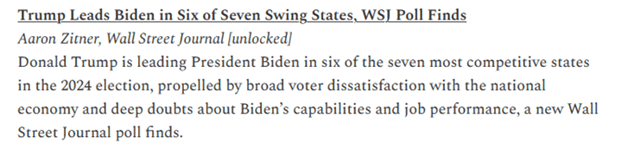
It’s inaccurate.
Poll results are estimates, not definitive statements about the world. The errors that accompany estimates are typically ignored.
If properly used, estimate errors are valuable information that yield a more precise understanding of the presidential race.
The headline should read, “WSJ Poll Finds Presidential Race to Close to Call.”
To make matters worse, WSJ provided reasons why Trump was ahead – voter dissatisfaction about the economy and public doubts about Biden’s capacity to perform as president.
Margin of error
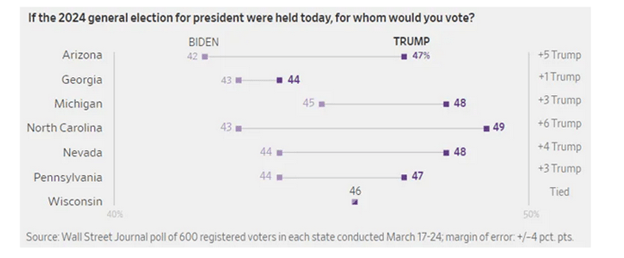
The article also presented this graph to show Trump’s lead across 7 battleground states. Notice at the bottom each state poll comprised 600 registered voters. This number produces a margin of error of plus/minus 4 percentage points.
Armed with this information, readers can come to their own conclusions.
Let me explain.
First, polling firms interview only a small proportion of the population (a representative sample). What the entire population thinks is unknown unless every single person in that population is interviewed. The margin of error describes how close we can expect the sample results to fall relative to the true population value.
In other words, sample estimates are guesses – they must be as only 600 people in the sample are used to estimate millions of Arizona voters. With any approximation there will be errors.
For example, the WSJ poll found 47% of Arizona registered voters would vote for Trump and 42% for Biden.
The margin of error reported of plus/minus 4 describes the amount of variability around Trump and Biden’s support levels.
Trump’s level of support therefore falls somewhere in this range: 43% to 51% – adding 4 to Trump’s 47% and subtracting 4 from 47%.
Using similar calculations, Biden’s level of support falls somewhere in this range: 38% to 46%.
It could be that Biden’s actual share is 46% and Trump’s 43%. It’s also possible that Trump’s percentage is 51% and Biden’s is 38%. Both are just as likely as the percentages reported by WSJ.
Second, to determine if Trump’s Arizona lead is real, we calculate a new margin of error for the difference between the two candidates. That margin of error is roughly twice the published margin of error.
So, in this case, it would be plus/minus 8.
Trump would need to be ahead by 8 percentage points or more to be confident that his lead is not due to chance alone – or sampling error.
None of the swing states show Trump leading by 8% or more. His lead in all swing states is within the margin of error.
The race is therefore too close to call.
Third, the justifications provided for Trump’s lead are now utterly insignificant.
Finally, the reported margin of error typically applies to estimates of the entire sample – registered Arizona voters. Specific subgroups like men or women that have fewer cases in the sample have much larger margins of error.
For example, the margin of error for estimates of Trump’s support among men double from 4 to 8. Smaller subgroups like Blacks or Latinos would mean even larger errors.
So, the estimated differences between subgroups – like men and women or Blacks and Latinos, must be substantial to be meaningful.
Bottom Line
From nearly a year ago, not much has changed in the presidential contest. The race remains too close to call. The differences in poll estimates published from one week to the next are most likely the result of sampling error. Nothing more.
Unfortunately, that doesn’t sell newspapers.
But it’s accurate.
For more details see Pew Research Center’s 5 key things to know about the margin of error in election polls.
 consider the politics