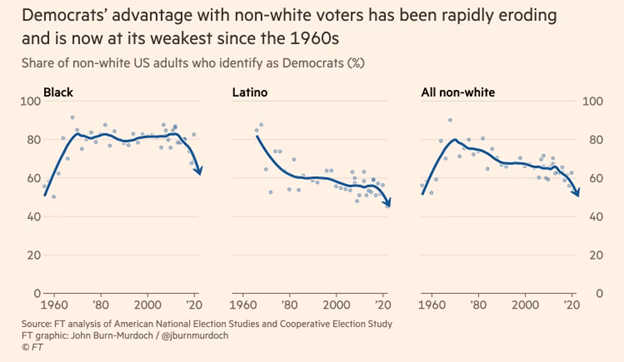
This chart comes from a recent piece in the Financial Times.
For many years, polling results demonstrated growing support for the Republican party among non-white voters. However, attention to the phenomenon was largely confined to a small group of Republican analysts and think tanks
Yet the trend continued and in recent years accelerated.
Now as we approach the election, more analysts are considering the changes
Below, is data from academic surveys dating back to the 1960s.
The share of non-white adults who identify as Democrats is dropping. Among Blacks, the share dropped steadily from 80 percent in the 1980s to just under 60 percent today.
The share of Latinos that identify as Democrats plunged from 80 to about 50 percent.
(see Gallup for similar data).
What’s going on?
The author suggests that Black and Latino conservatives are better sorted – that is, they are increasingly voting for the party that matches their ideology (see below).
Back in 2012, Black conservatives were much more likely to side with Democrats – notice Black conservatives were below the +0 line. That placement represents preference for Democrats. However, in the last few election cycles, Black conservatives show strong movement toward Republicans. By 2022, Black conservatives favored Republicans over Democrats.
The pattern for Latinos and Asians is even sharper.
You can compare all three groups to whites. Whites are the best sorted, aligning their ideology with their party preference.

We shall see whether these patterns hold and translate to Republican electoral successes.
An important caveat: While non-white groups appear better sorted – matching ideology to party, there are fewer group members that identify as conservative or very conservative. Many more Blacks, Asians, and Latinos identify as moderate or liberal.
Finally, in 2020, 9 percent of Blacks, 8 percent of Asians, and 35 percent of Latinos reported voting for Donald Trump.
Democrats should worry about this.
But Republicans must increase – substantially – the voting percentages of nonwhites from 2020 – especially in the swing states. Should that occur, we could be witnessing a major shift in party alliances.
 consider the politics